







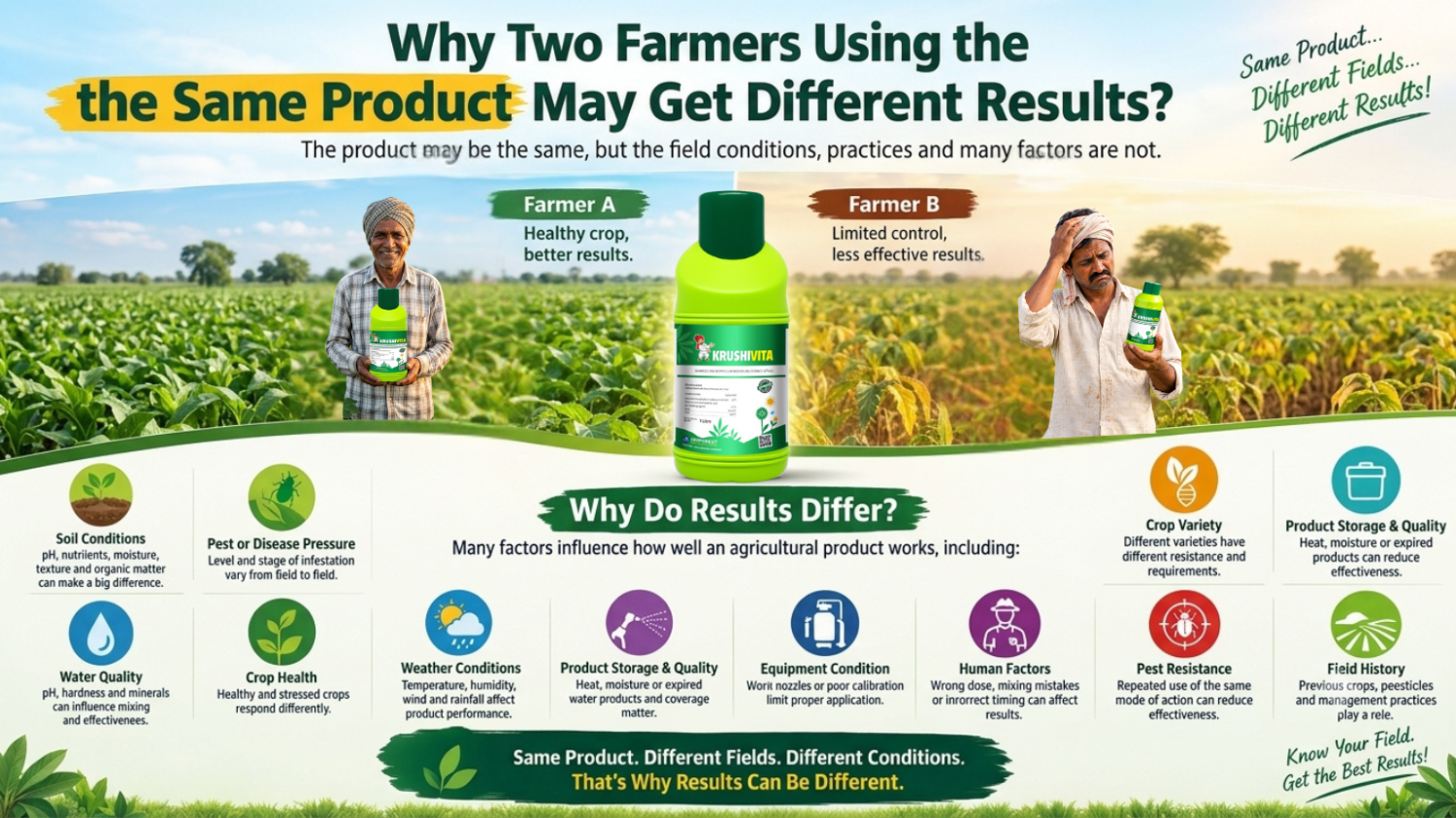
Why Two Farmers Using the Same Product May Get Different ResultS.
Have you ever wondered why the same agricultural product can provide excellent results in one field but a different result in another?
Two farmers may purchase the same pesticide, fungicide,
herbicide, fertilizer, or biostimulant and use it on the same crop, yet their
results may not be identical. This does not necessarily mean that the product
is ineffective or that one farmer has received a different product.
Agricultural performance is influenced by a combination of crop
conditions, soil properties, pest or disease pressure, weather, application
technique, product handling, timing, and overall farm management.
Understanding these factors is important for farmers,
retailers, and agricultural professionals because it helps set realistic
expectations and encourages better product-use practices.
1. Soil Conditions Can Be Different
One of the biggest reasons for different results is variation
in soil conditions.
Even when two farmers grow the same crop, their fields may
have different:
- Soil
pH
- Organic
matter
- Nutrient
levels
- Moisture
levels
- Soil
texture
- Salinity
- Drainage
- Microbial
activity
- Nutrient
availability
These factors can influence crop growth and the way
nutrients or agricultural products perform.
Example
Two farmers may apply the same fertilizer to soybean. If one
field has adequate soil moisture and balanced nutrients while the other has a
nutrient imbalance or poor root-zone conditions, the crops may respond
differently.
The product may be the same, but the field conditions are
not.
2. Pest or Disease Pressure May Be Different
The level of pest or disease infestation can vary
significantly between fields.
One farmer may have:
- Low
pest pressure
- Early-stage
infestation
- Younger
pest populations
while another field may have:
- Heavy
infestation
- Advanced
crop damage
- Multiple
pest species
- Different
pest life stages
The same pesticide may therefore produce different visible
results.
Why does pest stage matter?
Some crop protection products work best when pests are
targeted at a particular growth stage.
For example, controlling a pest population at an early stage
may be easier than managing a heavily established population.
Therefore, early identification and timely application
are important parts of crop protection.
3. Application Timing Matters
Timing can have a major effect on agricultural product
performance.
Farmers may use the same product but apply it at different:
- Crop
growth stages
- Pest
development stages
- Disease
stages
- Weed
growth stages
- Weather
conditions
A product applied at the recommended timing may perform
differently from the same product applied too early or too late.
The key principle
Right product + right timing = better opportunity for
effective results.
Always follow the product label and recommended application
timing.
4. Spray Quality Can Change the Result
For pesticides and foliar products, how the product is
sprayed can be just as important as which product is used.
Important factors include:
- Nozzle
type
- Spray
pressure
- Water
volume
- Droplet
size
- Spray
pattern
- Equipment
calibration
- Walking
or vehicle speed
- Spray
height
- Coverage
of the target
Two farmers may use exactly the same pesticide at the same
recommended dose but achieve different coverage.
Example
If one farmer achieves good coverage of the target plant
surface while another produces uneven coverage, the final result can differ.
This is why proper sprayer calibration and maintenance are
important.
5. Water Quality Can Affect Product Performance
Water is often the main carrier used for agricultural
sprays, but water quality can vary between farms.
Differences may include:
- pH
- Hardness
- Dissolved
minerals
- Salinity
- Suspended
particles
Depending on the product, water characteristics can
influence mixing, stability, or performance.
Farmers should therefore follow the product label and
manufacturer recommendations regarding water quality and spray preparation.
6. Weather Conditions Are Important
Weather can have a significant impact on agricultural
applications.
Factors such as:
- Temperature
- Humidity
- Wind
- Rainfall
- Sunlight
- Soil
moisture
can influence product performance.
Rainfall
If rainfall occurs shortly after an application, the product
may not perform as expected depending on the product, application method, and
label-specific rain fastness instructions.
Wind
Strong winds can cause spray drift and reduce the amount of
product reaching the intended target.
High Temperature
High temperatures can increase evaporation and may influence
crop stress and application performance.
Humidity
Humidity can affect drying conditions and disease
development.
Therefore, the same product applied under different weather
conditions may produce different results.
7. Crop Health Before Application Matters
A healthy crop and a severely stressed crop may respond
differently to the same agricultural input.
Crop stress can result from:
- Drought
- Waterlogging
- Nutrient
deficiency
- Excessive
heat
- Salinity
- Root
damage
- Pest
infestation
- Disease
infection
When a crop is already under severe stress, its ability to
recover or respond to a treatment may be limited.
This is why farmers should consider the overall condition
of the crop, rather than looking at the product alone.
8. Crop Variety Can Influence Results
Different varieties or hybrids of the same crop may respond
differently to pests, diseases, nutrients, and environmental conditions.
For example, two farmers may grow different varieties of
cotton.
Although both use the same crop protection product, their
crop response may differ because of differences in:
- Genetic
characteristics
- Disease
tolerance
- Pest
susceptibility
- Growth
pattern
- Crop
maturity
- Nutrient
requirements
Therefore, crop variety is another factor to consider when
evaluating field performance.
9. Application Dose Must Be Accurate
Using too little or too much product can affect results.
Underdosing
Using less than the recommended dose may result in
inadequate control.
Overdosing
Using more than the recommended dose does not necessarily
improve control and may increase:
- Crop
injury risk
- Input
cost
- Environmental
exposure
- Residue
concerns
- Resistance
selection pressure
The recommended dose should always be followed according to
the product label.
10. Mixing Practices Can Make a Difference
Farmers sometimes combine multiple products in a spray tank.
For example, they may mix:
- Insecticides
- Fungicides
- Herbicides
- Micronutrients
- Fertilizers
- Adjuvants
However, not every combination is compatible.
Incorrect tank mixing can potentially result in:
- Reduced
effectiveness
- Physical
incompatibility
- Poor
dispersion
- Crop
injury
- Changes
in product performance
Therefore, farmers should not assume that products can be
mixed simply because they are individually approved for agricultural use.
Always check the product label and manufacturer
recommendations before tank mixing.
11. Resistance Can Affect Pest Control
Sometimes a farmer may report that a pesticide "did not
work," even though the same product worked well in another field.
One possible explanation is pest resistance.
Repeated use of the same mode of action can contribute to
the selection of resistant pest populations.
Resistance can vary between locations and pest populations.
This is one reason why responsible resistance-management
practices, including appropriate mode-of-action rotation and integrated pest
management, are important.
12. Field History Matters
Every agricultural field has its own history.
Previous practices may include:
- Crops
grown in previous seasons
- Pesticides
used
- Fertilizer
applications
- Irrigation
practices
- Weed-management
practices
- Pest-management
strategies
- Soil
amendments
For example, a field with a history of repeated use of
products with the same mode of action may have a different pest-management
situation from a field with a more diversified program.
Field history can influence current crop and pest
conditions.
13. Soil Moisture and Irrigation Can Influence Results
Water availability is essential for crop growth and nutrient
movement.
Too little moisture can lead to:
- Poor
plant growth
- Reduced
nutrient uptake
- Crop
stress
- Reduced
recovery after pest or disease damage
Excess moisture can contribute to:
- Waterlogging
- Root
problems
- Nutrient
losses
- Favorable
conditions for certain diseases
Therefore, irrigation and drainage conditions can contribute
to different outcomes even when the same product is used.
14. Product Storage Can Affect Quality
Correct storage is especially important for agricultural
inputs.
Products exposed to unsuitable conditions such as:
- Excessive
heat
- Direct
sunlight
- Moisture
- Freezing
conditions where relevant
- Damaged
packaging
may not perform as expected.
Farmers and retailers should follow the storage conditions
specified on the product label or manufacturer's instructions.
Checking the expiry date, batch information, packaging
condition, and storage requirements is also important.
15. Application Equipment Can Make a Difference
Two farmers may use the same product with completely
different equipment.
For example:
Farmer A:
Uses a properly calibrated sprayer with suitable nozzles and uniform pressure.
Farmer B:
Uses worn nozzles, inconsistent pressure, or poorly calibrated equipment.
Even though both farmers use the same product and nominal
dose, the amount actually reaching the target may differ.
Regular equipment inspection and calibration can help
improve application consistency.
16. Human Factors Also Matter
Agriculture involves many practical decisions, and small
differences in execution can influence results.
These may include:
- Measuring
the product incorrectly
- Using
the wrong water quantity
- Incorrect
mixing
- Poor
nozzle selection
- Uneven
walking speed
- Spraying
outside the recommended conditions
- Incorrect
application timing
- Failing
to maintain equipment
This is why following the product label carefully is just
as important as selecting the product.
17. One Product Does Not Solve Every Agricultural Problem
Another important point is that agricultural products are
designed for specific purposes.
An insecticide is intended to manage specified insect pests.
A fungicide is intended to manage specified fungal diseases.
A herbicide is intended to manage specified weeds.
A fertilizer supplies nutrients.
A bio stimulant may support particular physiological
processes depending on the product.
If the underlying problem has been incorrectly identified,
even a high-quality product may not provide the expected result.
Correct diagnosis comes first.
Before choosing a product, identify:
What is the problem?
→ Pest?
→ Disease?
→ Weed?
→ Nutrient deficiency?
→ Environmental stress?
Correct problem identification is an important first step in
effective crop management.
18. Product Quality and Authenticity Matter
Agricultural products should be purchased from reliable
sources and checked for appropriate labeling and packaging.
Farmers should pay attention to:
- Product
name
- Active
ingredient
- Formulation
- Batch
number
- Manufacturing
details
- Expiry
date
- Registration
or applicable regulatory information
- Manufacturer
information
- Packaging
condition
Purchasing from reliable channels can help reduce the risk
of counterfeit, damaged, or improperly stored products.
19. Results Should Be Evaluated Properly
Farmers should avoid judging a product immediately after
application unless the product label specifies an immediate effect.
Different products work at different speeds.
Evaluation may depend on:
- Target
pest
- Target
disease
- Product
mode of action
- Crop
stage
- Environmental
conditions
- Application
timing
Instead of asking only:
"Did the product work?"
it can be more useful to ask:
- Was
the problem correctly identified?
- Was
the product appropriate for that problem?
- Was
the recommended dose followed?
- Was
the application made at the correct time?
- Was
spray coverage adequate?
- Were
weather conditions suitable?
- Was
the product stored correctly?
- Is
resistance a possible factor?
This creates a more accurate assessment.
Same Product Does Not Mean Same Conditions
The most important lesson is that agriculture is a
biological system.
A product does not operate in isolation.
Its performance is influenced by the interaction between:
Product + Crop + Pest/Disease + Soil + Weather +
Application + Management
Two farmers may use the same product, but if even one or
more of these factors differ significantly, the outcome may also differ.
How Farmers Can Improve Consistency
Farmers can take several practical steps to improve the
consistency of agricultural applications:
Before Application
- Identify
the crop problem correctly.
- Check
the product label.
- Confirm
the recommended crop and target.
- Check
the recommended dose.
- Check
weather conditions.
- Inspect
spraying equipment.
During Application
- Measure
accurately.
- Use
the recommended water volume.
- Maintain
proper spray pressure.
- Ensure
suitable coverage.
- Avoid
unnecessary drift.
- Follow
the recommended application method.
After Application
- Monitor
the crop.
- Observe
pest, disease, or weed response.
- Record
the date and product used.
- Monitor
weather conditions.
- Evaluate
results according to the expected response period.
Maintaining basic farm records can also help farmers
understand which practices perform consistently under their own field
conditions.
Frequently Asked Questions
Why does the same pesticide work differently on different
farms?
Because field conditions vary. Pest pressure, crop stage,
weather, soil, water quality, application technique, resistance, and other
management factors can influence performance.
Does a higher pesticide dose always give better results?
No. Applying more than the recommended dose does not
necessarily improve control and may increase crop injury, cost, environmental
exposure, and resistance-related risks.
Can weather affect pesticide performance?
Yes. Rainfall, wind, temperature, humidity, and other
environmental conditions can influence application and performance. Always
follow the product-specific label instructions.
Why is spray coverage important?
The product needs to reach the intended target at an
appropriate concentration. Poor or uneven coverage can reduce the effectiveness
of a spray application.
Can water quality affect pesticide applications?
Yes. Depending on the product, water pH, hardness, dissolved
minerals, and other characteristics can influence mixing or performance.
Why might a pesticide fail even when the correct dose was
used?
Possible reasons include incorrect pest identification,
advanced infestation, resistance, poor coverage, unsuitable weather, incorrect
timing, incompatible tank mixing, or improper product storage.
Should farmers change products if results are poor?
Not automatically. First determine why the expected result
was not achieved. The problem may be related to diagnosis, timing, application,
weather, resistance, or another field condition. Product changes should be
based on the specific crop-protection situation and label recommendations.
Conclusion
The performance of an agricultural product depends on much
more than the product itself. Two farmers can use the same product at the
recommended rate and still experience different results because their fields,
crops, pest pressure, weather, soil conditions, application methods, and
management practices may be different.
The key to achieving more consistent results is to focus on
the complete application process:
Correct Problem → Correct Product → Correct Dose →
Correct Timing → Correct Application → Proper Monitoring
Farmers should always read and follow the product label, use
agricultural inputs responsibly, maintain application equipment properly, and
consider local crop and field conditions.
Ultimately, successful crop management is not simply about
finding a product—it is about using the right agricultural practice under
the right conditions.
Better Knowledge. Better Application. Better Crop
Management.

AgroOrbit is known for supplying Fertilizers, Pesticides, Plant Growth Regulators and Equipment that are required in agriculture. We provide guaranteed market's best price and customer support. Our USP is Negotiation with us.
With customer satisfaction as the central idea of the business, AgroOrbit has become one of the leading and reliable sources of agricultural products and equipments.Our goal is providing the right products to our customers and farmers. we are also providing a platform to small retailers with the facility to became a seller.



Contact Info
- Address: Khasra No. 16/7, Street No 8, Swaroop Nagar, North Delhi, Delhi - 110042
- Phone: 1800 313 36899
- Email: Info@agroorbit.com