







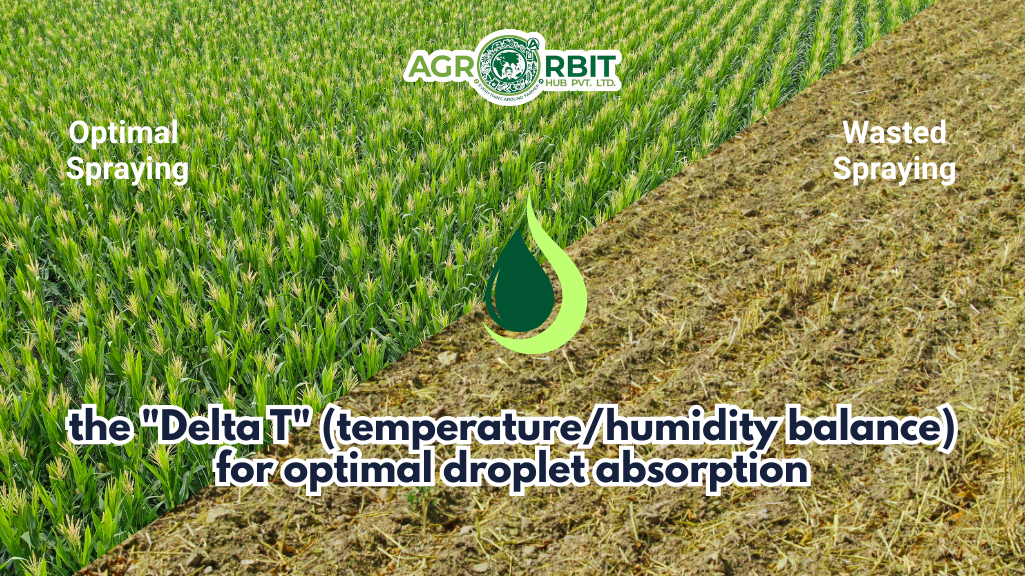
the "Delta T" (temperature/humidity balance) for optimal droplet absorption
Delta T is a measure of evaporative potential. It represents the relationship between dry bulb temperature (ambient air temperature) and wet bulb temperature (which reflects humidity).
While most
farmers look only at the temperature, Delta T tells you how much
"stress" the atmosphere is putting on a liquid droplet. It determines
how long a pesticide droplet stays in liquid form on the leaf surface before it
evaporates.
1. The
Biological Necessity of the "Liquid Phase"
For a
pesticide to work, the active ingredient must be in a liquid state to
pass through the plant's waxy cuticle or be ingested by a pest.
- The High Delta T Problem: If the air is hot and dry (High
Delta T), the water in the droplet evaporates almost instantly. The
pesticide then turns into a dry crystal or powder on the leaf. In this
solid state, the plant cannot absorb it, rendering the application
useless.
- The Low Delta T Problem: If the air is too humid (Low
Delta T), the droplet never dries. This can lead to "run-off,"
where the chemical slides off the leaf and onto the soil, or it can keep
the chemical active for too long, causing "leaf burn"
(phytotoxicity).
2. The
Delta T Spraying Zones
Professional
agronomists divide Delta T into four distinct zones to guide field operations:
|
Delta
T Value |
Category |
Agricultural
Action |
|
Below 2 |
Very
Low |
Avoid
Spraying. High
risk of run-off and chemical "wash-off." Droplets won't stick. |
|
2 to 8 |
The
Sweet Spot |
Ideal
for all sprays. Maximum
absorption for systemic herbicides and fungicides. |
|
8 to 10 |
Marginal |
Proceed
with Caution. Use
larger nozzles and "stickers" (adjuvants) to prevent rapid drying. |
|
Above
10 |
Critical |
Stop
Spraying.
Evaporation is too fast. High risk of droplets turning into "fine
mist" and drifting away. |
3. Why
Humidity Alone is a Trap
Many farmers
make the mistake of spraying based on temperature or humidity individually.
- Scenario A: 25°C at 30% Humidity. (Delta T
is ~7 — Good to spray)
- Scenario B: 35°C at 30% Humidity. (Delta T
is ~11 — Do not spray)
Even though
the humidity is the same (30%), the 10-degree increase in heat in Scenario B
makes the air significantly more "thirsty," causing the spray to
fail. Delta T combines these two factors into a single, reliable number for
decision-making.
4. Impact
on the Farmer’s Bottom Line
Integrating
Delta T into your farm management provides three major benefits:
1.
Chemical Savings: Every drop of expensive chemical you buy stays on the target rather than
evaporating.
2.
Pest Control Reliability: You won't have to "re-spray" because the first
application failed to be absorbed.
3.
Resistance Management: Applying a pesticide in poor conditions often results in a
"sub-lethal dose" (not enough chemical enters the pest), which is
exactly how "Superbugs" develop resistance.
Summary
for the Field
Think of
Delta T as the "Absorption Window." If you spray outside that
2–8 window, you are essentially gambling with your crop protection budget. To
monitor this, farmers can use handheld weather meters or modern agricultural
apps that pull real-time local weather data.

AgroOrbit is known for supplying Fertilizers, Pesticides, Plant Growth Regulators and Equipment that are required in agriculture. We provide guaranteed market's best price and customer support. Our USP is Negotiation with us.
With customer satisfaction as the central idea of the business, AgroOrbit has become one of the leading and reliable sources of agricultural products and equipments.Our goal is providing the right products to our customers and farmers. we are also providing a platform to small retailers with the facility to became a seller.



Contact Info
- Address: Khasra No. 16/7, Street No 8, Swaroop Nagar, North Delhi, Delhi - 110042
- Phone: 1800 313 36899
- Email: Info@agroorbit.com