











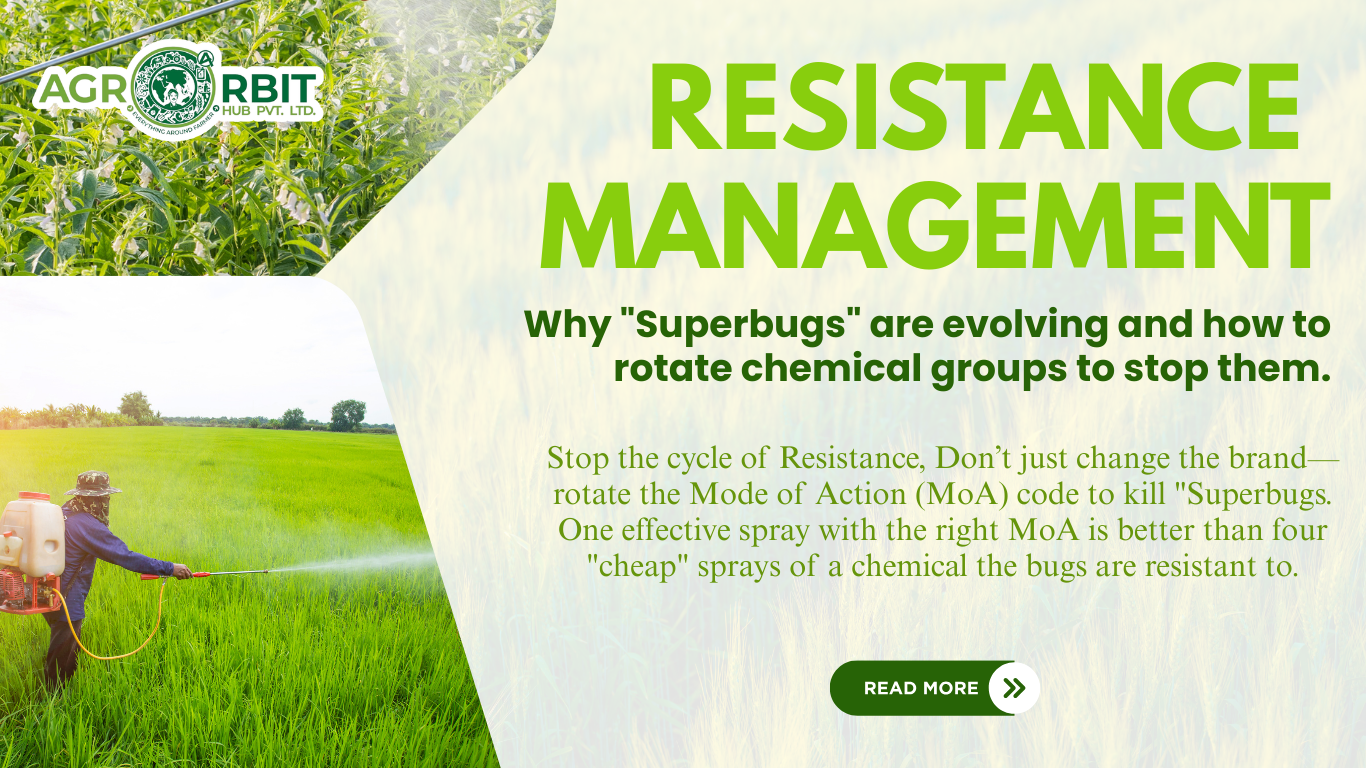
Resistance Management: Why "Superbugs" are evolving and how to rotate chemical groups to stop them.
The evolution of "Superbugs" in agriculture is a classic example of natural selection happening in real time. When a pesticide fails to kill a small percentage of a pest population, those survivors pass on their resistant genes, eventually rendering that chemical useless.
Effective Insecticide
Resistance Management (IRM) is about staying one step ahead of the
pest's biology.
1. The
Biology of Resistance: How Superbugs Evolve
Resistance
isn't a "choice" by the insect; it is a genetic lottery.
- Genetic Variation: In any population of
millions of insects, a few individuals will have a natural mutation that
allows them to detoxify a specific chemical.
- Selection Pressure: When you spray the same
pesticide repeatedly, you kill the "susceptible" insects. The
"resistant" ones survive, thrive, and breed.
- The "Bottle-Neck"
Effect: Within
a few generations (which can take only weeks for some pests), the entire
population consists of descendants of those survivors. You now have
a superbug.
2.
Understanding Mode of Action (MoA)
To fight
resistance, you must understand how the chemical kills. This
is known as the Mode of Action (MoA). If you use two different
brands of pesticide, but they both attack the insect’s nervous system in the
same way, the insect will be resistant to both.
The IRAC
(Insecticide Resistance Action Committee) classifies chemicals into
numbered groups:
|
Group
Number |
Target
Site |
Example
Chemicals |
|
Group 1 |
Nervous
System (AChE) |
Organophosphates,
Carbamates |
|
Group 3 |
Nerve/Muscle
(Sodium channels) |
Pyrethroids
(e.g., Deltamethrin) |
|
Group 4 |
Nervous
System (nAChR) |
Neonicotinoids
(e.g., Imidacloprid) |
|
Group 5 |
Nervous
System (Allosteric) |
Spinosyns |
|
Group
18 |
Growth/Molting
(Ecdysone) |
Diacylhydrazines |
3. How to
Rotate Chemical Groups (The "Window" Strategy)
Rotating
chemicals isn't just about picking a different bottle; it’s about picking a
different group number.
The
"Generation Window" Concept
A
"window" is usually defined as the length of one generation of the
target pest (e.g., 30 days).
1.
Window 1: Use
a chemical from Group A. If you need to spray twice in this window,
stay within Group A.
2.
Window 2: Switch
to Group B. This ensures that any offspring of survivors from
Window 1 (who might be resistant to Group A) are hit with a completely
different biological weapon.
3.
Window 3: Switch
to Group C or return to Group A only if enough time has
passed.
4.
Strategic Tactics to Prevent Resistance
Beyond
simple rotation, use these "Best Management Practices" (BMPs):
- Avoid "Sub-Lethal"
Doses: Cutting
the dose to save money is a recipe for disaster. Low doses kill only the
weakest bugs, effectively "training" the rest of the population
to tolerate the chemical.
- Refugia (The "Safe
Zone"): In
some cases (especially with Bt crops), farmers leave a small area
untreated. This allows "susceptible" bugs to survive and mate
with any "resistant" bugs from the treated area, diluting the
resistance genes in the next generation.
- Synergists: Sometimes, adding a
non-toxic booster (like Piperonyl Butoxide) can block the enzymes the
insect uses to break down the pesticide, making the chemical effective
again.
- Integrated Pest Management
(IPM): Use
biological controls (ladybugs, parasitic wasps) and mechanical controls
(traps) so you don't have to rely solely on chemistry.
Conclusion:
Agricultural
"Superbugs" evolve when the repeated use of a single pesticide kills
only weak insects, leaving behind a resistant few to breed and pass on their
"survivor" genes. To stop this cycle, farmers must practice Resistance
Management by rotating between different chemical groups based on
their Mode of Action (MoA) codes. By constantly switching how
they attack the pest's biology and integrating natural controls, growers can
prevent chemicals from becoming useless and ensure long-term crop protection.

AgroOrbit is known for supplying Fertilizers, Pesticides, Plant Growth Regulators and Equipment that are required in agriculture. We provide guaranteed market's best price and customer support. Our USP is Negotiation with us.
With customer satisfaction as the central idea of the business, AgroOrbit has become one of the leading and reliable sources of agricultural products and equipments.Our goal is providing the right products to our customers and farmers. we are also providing a platform to small retailers with the facility to became a seller.



Contact Info
- Address: Khasra No. 16/7, Street No 8, Swaroop Nagar, North Delhi, Delhi - 110042
- Phone: 1800 313 36899
- Email: Info@agroorbit.com